Hey there 👋 Steve here — and if there’s one thing I’ve seen countless times in my 20+ years as a mechanic, it’s this: most dead batteries don’t come out of nowhere. They give you warnings, you just have to catch them before it’s too late.
You know that feeling — you’re running late for work, jump in your car, turn the key… and click-click-click. Nothing. 😩
Your morning’s ruined, your coffee’s cold, and now you’re waiting for a tow truck.
But here’s the thing — all of that could have been avoided with a simple battery test that takes less than five minutes. In this guide, I’ll show you how to spot the signs of a weak battery, how to test it, when to replace it, and why professional car battery testing and replacement can save you a ton of stress.
Your car battery has one main job — to store and deliver power to start your engine and run all the electronics. But it doesn’t last forever.
Most batteries last between 3 and 5 years, depending on how and where you drive. The tricky part? They usually die with little notice, and always when you least expect it — on a cold morning, in the grocery store parking lot, or when you’re already late for work.
Here are the main reasons they fail:
💬 I once had a customer whose battery died right after she filled up her gas tank. She thought the pump had drained the car’s power somehow — but really, her 6-year-old battery finally gave out. One quick test a month earlier could’ve saved her a tow bill.
Most dead batteries don’t die instantly — they fade out. If you pay attention to the signs, you can usually catch the problem early.
Here’s what to watch for:
If your car is acting “lazy” when starting, that’s your battery whispering for help — don’t wait for it to go completely silent.
You don’t need to be a professional mechanic to check your car battery’s health. Here’s how you can do it safely:
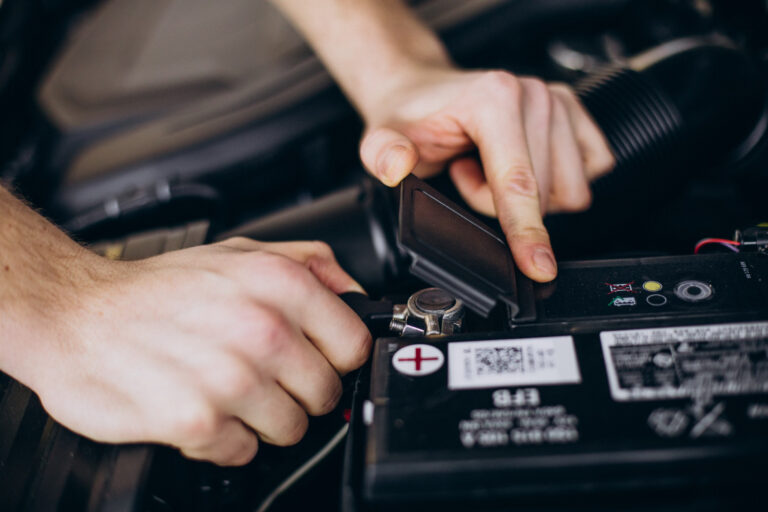
Pop the hood and take a look at the battery:
If you see corrosion, you can clean it with a little baking soda and water mixture — just make sure the car’s off and you’re wearing gloves.
Turn your headlights on before starting the engine. Then, while the lights are on, start the car.
Set it to DC voltage and connect it to the battery terminals:
A professional battery test checks how your battery performs under stress (the way it does when starting your car). At Kingdom Autocare, we use advanced diagnostic tools that simulate real-world conditions to test the battery, alternator, and starter — all in about 10 minutes.
💬 I had a customer whose battery tested at 12.3 volts at home — not terrible, right? But when we put it under load in the shop, it dropped below 10 volts instantly. It would’ve failed within days.
Even the best batteries wear out. Here’s when you should start planning for car battery replacement:
Waiting too long can damage other parts like the alternator or starter, since they work harder trying to make up for a weak battery.
💬 One of my regular customers ignored his battery issues for months — he just kept jump-starting it. Eventually, the constant strain burned out his alternator, turning a $180 fix into a $700 repair.
Lesson learned: don’t wait until it leaves you stranded.
Sure, you can test a battery at home — but professional car battery testing and replacement goes deeper.
At Kingdom Autocare, here’s what we do when a customer brings in a car for a battery check:
This way, you know whether you actually need a new battery — or if there’s another issue draining it.
We also make sure you get the right battery for your car: correct group size, cold cranking amps (CCA), and reserve capacity for your specific model and climate.
💬 I once replaced a customer’s battery that wasn’t even the right size for her car — it had been installed by a quick-lube place. No wonder it kept dying! Using the wrong battery is like wearing shoes two sizes too small — they might fit for a while, but they won’t last long.
Once you’ve got a healthy battery, here’s how to keep it that way:
A little preventive care goes a long way.
Look, your car battery might not seem like a big deal — until it dies at the worst possible time. I’ve seen it happen too many times: stranded drivers, missed meetings, even folks stuck in parking lots at night.
The good news? A simple battery test can prevent all that. It’s fast, it’s cheap (or free), and it could save you a tow truck call and a whole lot of stress.
Your car gives you warning signs — slow starts, dim lights, little clues that it’s struggling. Don’t ignore them.
If your car’s been slow to start, or your battery’s more than three years old, don’t wait for it to leave you stranded. Come see us at Kingdom Autocare.
We’ll test your battery, check your charging system, and help you choose the right replacement if needed — all in about 10 minutes.
👉 Book your free battery test today and drive with peace of mind knowing you won’t get stuck next time you turn the key.
Your car will thank you — and so will your future self. 😉🔋
— Steve